Black History Month Spotlight: Doris Jones on Decades of Dialysis Care
Dialysis technician Doris Jones has spent 48 years showing up for her patients. She's just getting started.
Written by
By Ivy Shelden
Published
26 February 2026
Blog /
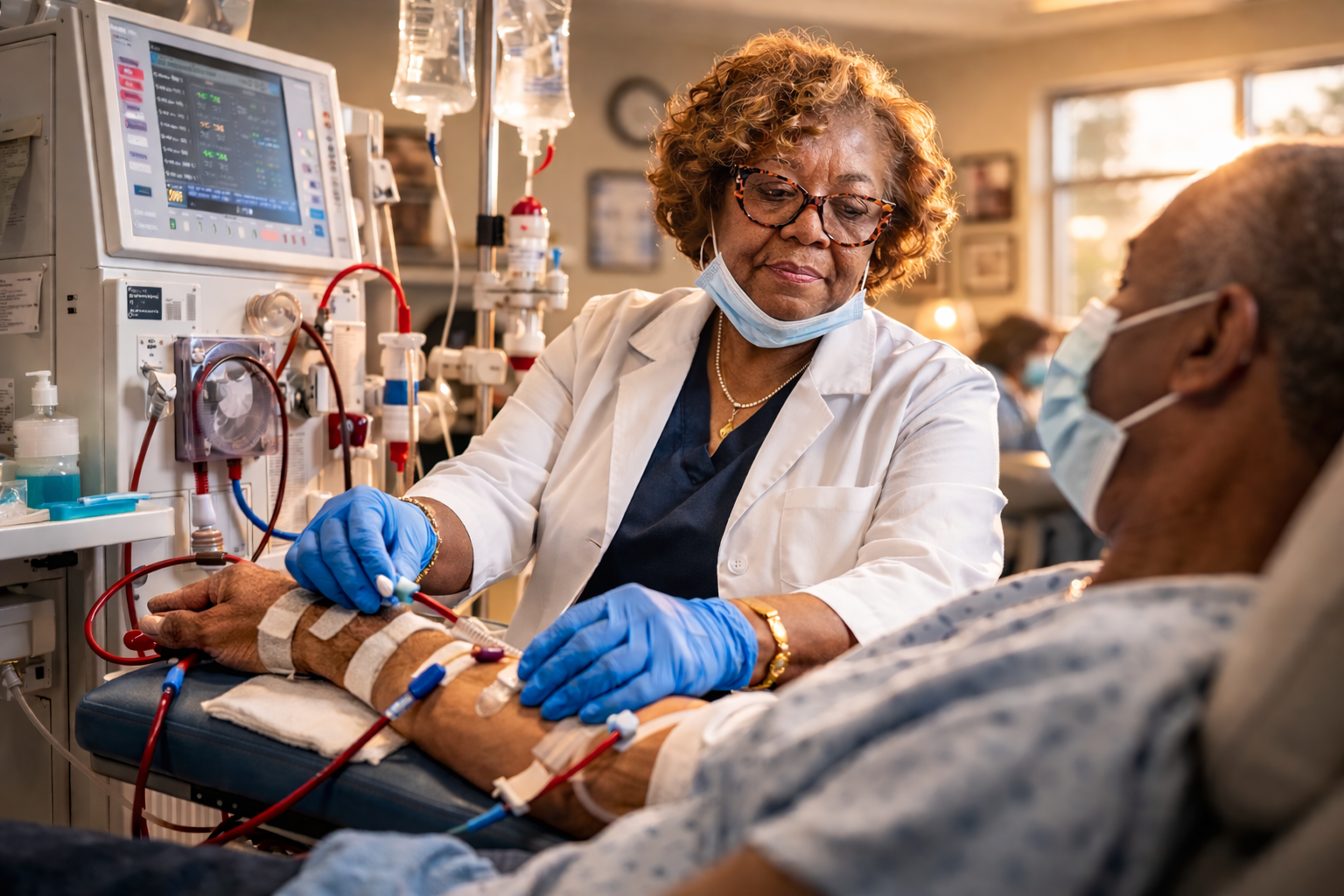
Doris Jones has been a dialysis technician for over four decades.
Not because the road was easy.
And not because anyone told her to stay.
Because, as she puts it, “my patients need me.”
For Doris, this commitment to caregiving goes all the way back to childhood.
A Caregiver by Nature
Before Doris ever set foot in a clinic, she was already trying to take care of people.
She grew up around illness. There was always someone in the family dealing with a health issue, close relatives or distant ones. From the time she was a small child, Doris couldn't just stand by and watch.
“I didn’t like to see people sick,” she says. “I remember as a kid, when people were sick, I was crying. I wanted to feed them. I didn’t want anybody else to feed them because I didn’t think they knew how to feed them correctly. They just didn’t have that compassion.”
She laughs a little telling this story. But the impulse behind it, that deep need to step in and do more, never went away.
“I thought…I could do better,” she says. “I still feel I can do better!”
How a TV Show Changed Everything
Doris was already working in a hospital when her career path shifted.
One evening in the 1970s, she watched an episode of Marcus Welby, MD that featured patients on dialysis. She had already noticed dialysis machines moving through the hallways at work, which piqued her curiosity. The episode made her act on it.
“It was really interesting and I wanted to get into it,” she says. “So I searched and found out how to get into it and that’s how I got into it.”
That was more than 48 years ago.
“I love it,” she says.
Breaking Into Patient Care
The beginning wasn’t easy.
When Doris first entered dialysis care, she was assigned to setup and teardown. For weeks, she prepared the machines and broke them down again. No patient contact, just the work behind the scenes.
“At that time I found that, coincidentally, a lot of the Blacks always started off with this setup and teardown before you got into patient care,” she says. “You almost had to be liked to get into that part, unfortunately.”
She got through it. She earned her way into patient care, built her knowledge and her reputation, and kept going. Now she’s coaching the next generation of dialysis caregivers.
What 48 Years of Patient Care Looks Like
When asked how she supports patients going through dialysis, Doris doesn't hesitate.
“You listen. You listen. You listen.”
For many patients, the first visit comes after devastating news. They’ve just been told they have end-stage renal disease. They walk in overwhelmed.
“When people come in at first, they’re usually like, ‘why me? I’m about to die, this is the end, I haven’t lived my life,’” Doris says.
“And I just come down to rare earth with them. I say, ‘You’re gonna be all right, we got this.’”
There were times when she cried alongside them.
“I could feel their pain,” she says. “The uncertainty, I could feel it.”
She helps ground patients through gratitude and perspective. She tells them:
“We’re not going to let this here stop us because we have no shoes. Because there’s somebody down the street who has no feet.”
Over the years, she has witnessed remarkable resilience in the people receiving treatments.
“I haven’t had a patient yet that didn’t get through it,” she says.
Quietly Going Above and Beyond
There’s a part of Doris's story she doesn't love talking about. Not because it's painful, but because she genuinely doesn't want it to sound like bragging.
Over the years, she has stepped in when patients couldn’t afford what they needed. For example, a piece of furniture to hold a dialysis machine, transportation to a doctor’s visit, or childcare during holidays.
“You do it from your heart,” she says. “I don’t like for it to feel like you’re bragging about it, because you do it from your heart and you just do what has to be done.”
And she’s very clear about who deserves her help.
“It doesn’t matter what race they are. It doesn’t matter what gender they are. It doesn’t matter how old they are. We all need help sometimes.”
Why She Keeps Coming Back
When asked what the biggest challenge of her work has been, Doris pauses.
“I don’t look at this as a challenge. I really don’t,” she says. “You just do. The Lord gives me strength and I just do.”
What keeps her coming back is simple:
“I come back because my patients need me. I get up at one to two o'clock every morning on some days and go in because my patients need me. I go on vacation and my patients call me and I answer because my patients need me. That keeps me going."
But to Doris, they’re not just patients.
“Every one of those patients could be my loved ones, could be my sister, could be my brother, could be my child, could be my grandchild, they could be my bestie,” she says. “And I would want someone to help, to reach out and help them. And I do the same thing with my patients. They’re my family.”
Bringing Care Home: The Herewith Partnership
One of the realities Doris understands after decades in dialysis is how hard it is for patients to simply get to their treatment appointments.
She’s seen those barriers up close.
“Sometimes they don't have transportation. Sometimes they don't physically feel well enough to make it out there. Sometimes they mentally don't feel well enough to get out there. And for someone to come to their home and give them their treatment and their care…it's a great thing."
Doris has coached Helpers as part of Herewith’s partnership with Sanderling Renal Care. She says every Helper she’s worked with has been eager to learn.
"I believe the growth is unlimited for Herewith," she says. "There's thousands and thousands of patients out here that need the service."
"It's a great marriage," she says. "It's giving the patients and staff the opportunity to take care of each other."
What She’s Most Proud of
Her answer is characteristically humble.
“That I’ve been able to do it for 48 plus years,” she says. “I’m appreciative that I’ve had the opportunity to do it.”
She pauses.
“I’m just blessed. I’m truly blessed.”
Herewith partners with Sanderling Renal Care to support in-home dialysis care.
Still need help?
Call our Support team for further assistance.
Mon-Sat, 9AM-6:30PM PT- Call us at:
415-506-9776
- Send us an email
support@herewith.com





Herewith provides a platform to assist Helpers and care recipients in connecting regarding in-home non-medical care opportunities. Herewith does not employ any Helpers, nor does it recommend any Helpers and/or care recipients who use its platform. User information provided in profiles, posts, and otherwise on the Herewith platform is not generated or verified by Herewith. Each user of Herewith's platform is responsible for conducting their own vetting before determining whether to enter into an employment relationship and for their own conduct, including compliance with applicable laws.